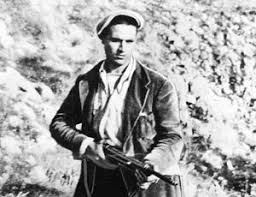
Salvatore Giuliano: Sicilian Independence Hero or Outlaw?
For true Sicilians, Salvatore Giuliano was and will always be a hero—a patriot who fought for Sicily’s freedom against a criminal state that treated Sicilians as slaves. For traitors and Italian politicians, however, he will always be considered an outlaw. His story intertwines with the destiny of Sicily and the geopolitical interests of the world’s great powers.
The Colonel of E.V.I.S and the Dream of a Free Island
Salvatore Giuliano was not just a simple outlaw but the colonel of the Volunteer Army for the Independence of Sicily (E.V.I.S.), an armed organization fighting to free Sicily from Italian rule. His dream was an autonomous Sicily, far from the oppression and exploitation that had suffocated the Sicilian people for centuries.
With financial support from the Americans, the Sicilian independence movement saw the possibility of transforming Sicily into the 49th American state. The United States viewed the island as a crucial strategic base in the Mediterranean. However, the death of President Franklin D. Roosevelt halted this possibility. His successor, Harry Truman, decided not to pursue this path to avoid provoking the Soviet Union and triggering another world war.
The Role of the Communist Party and the Vatican’s Intervention
In 1947, the Italian Communist Party gained significant support in Sicily, promising land redistribution to the peasants. This deeply alarmed the Vatican, which feared the rise of communism and pressured Truman not to support Sicilian independence. As a result, Sicily remained under Italian control, while the Americans decided to maintain one of their largest military bases in Italy, in Sigonella.
The Fate of Salvatore Giuliano: Death or Exile?
The official version claims that Salvatore Giuliano was killed in 1950 under unclear circumstances. However, another theory, supported by some witnesses and researchers, suggests that Giuliano was never actually killed but managed to escape to the United States. According to this version, he lived up to 100 years in America, continuing to pray for an independent Sicily until his last breath.
An Eternal Symbol for Sicily
Salvatore Giuliano remains a controversial figure, but for many Sicilians, he is a symbol of resistance against oppression and the fight for freedom. His dream of a free and prosperous island continues to live on in the hearts of those who still believe in a better future for Sicily.
Today, his story is more relevant than ever. Sicily continues to be exploited, while local politicians grow richer at the expense of the people. But Giuliano’s memory teaches us that the struggle for justice and freedom never ends. With the new President of the United States considering expanding the American geographical map, we Sicilian Americans—who outnumber the Sicilians in Sicily—now have a renewed dream of making Sicily the 51st American state, since we did not succeed in becoming the 49th. We call upon all Sicilians worldwide, especially Sicilian Americans, to join this cause.
Sicily would once again become the center of the world. Sicilians would gain more respect than what Italy has given us since its unification, treating us as second-class citizens. Our agricultural products would boom in exports, our tourism industry would triple, and social injustice would disappear. We would have an American-style judicial system, where convictions are based on evidence and not hearsay, unlike what happens in Italy today. According to a survey, 65% of convicted prisoners in Italy are innocent, prison suicides are the highest in Europe, and prison overcrowding has led to multiple sanctions against Italy by Amnesty International. The Sicilian people would have everything to gain.
But who would lose? The Italian political system would lose, as it would no longer have Sicilians as scapegoats for its criminal actions. Dishonorable Sicilian politicians would also lose, as they could no longer grant themselves salaries thirty times higher than those of a construction worker, a schoolteacher, a carpenter, a traffic officer, or a policeman. The right to an honest life would finally be easier to achieve. Sicilians would no longer be seen as mafiosi by those who do not know them but as citizens of the most beautiful island in the world, part of the most powerful country in the world.
For that minority of anti-American Sicilians, there would always be the option to move to Northern Italy, where they would be warmly welcomed. Meanwhile, Sicilians around the world, who respect and dream of one day returning to their homeland, would finally see their desire fulfilled—to no longer feel like second-class citizens.